
The Importance of Proper Cargo Securing
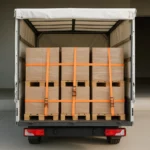
Securing cargo during road transport is not only a legal requirement but, above all, a matter of safety for all road users. Improperly secured cargo can shift while the vehicle is in motion, causing the driver to lose control of the vehicle, the truck to overturn, or the cargo to fall onto the roadway. Every year, accidents caused by improperly secured cargo occur on European roads, resulting in injuries, property damage, and traffic congestion.
SLAWA sp. z o.o., z 15-letnim doświadczeniem w transporcie specjalistycznym, traktuje zabezpieczenie ładunku jako absolutny priorytet. Nasi kierowcy przechodzą regularne szkolenia z prawidłowego mocowania różnych rodzajów ładunków, a każdy pojazd wyposażony jest w profesjonalny sprzęt zabezpieczający. Certyfikaty ISO 9001:2015 oraz ubezpieczenie do 1 000 000 EUR potwierdzają nasze zaangażowanie w najwyższe standardy bezpieczeństwa.
Fundamentals of Transport Physics
Forces Acting on a Load
During transportation The cargo is subjected to various forces resulting from the vehicle's motion:
Acceleration and Braking – When the vehicle accelerates, the cargo “tends” to remain in place, exerting pressure on the front walls of the cargo area. When braking, the opposite occurs—the cargo is pulled forward, which is the most common cause of shifting.
Turns – Centrifugal forces acting when driving through curves are perpendicular to the direction of travel and tend to push the load sideways. The sharper the curve and the higher the speed, the greater the forces.
Road Irregularities – Potholes, speed bumps, and railroad crossings cause vertical impacts that can loosen securing devices or damage the cargo.
Vibrations – Constant vibrations while driving can gradually loosen the fasteners, so it is necessary to check them when the vehicle is parked.
Standards and Coefficients
According to the European standard EN 12195-1, load securing must withstand the following forces:
- 0,8g in the direction of travel (forward)
- 0,5g in the opposite direction (backward)
- 0,5g in lateral directions
- 1,0g vertically (upward)
This means that for a load weighing 1,000 kg, the restraints must be able to withstand a forward force of 800 kg during braking.
Methods for Securing Cargo

Blocking
Securing is a method that involves filling the empty space around the load to prevent it from shifting. It is used:
Blocking with the vehicle's sides – Place the cargo directly against the cab wall, the rear wall, or the sides of the trailer. The walls must be strong enough to withstand the forces.
Strut beams – Metal or wooden beams mounted between the walls of the trailer, forming “artificial walls” that divide the cargo area.
Airbags – Inflatable cushions placed between pallets or cardboard boxes to fill empty spaces and prevent shifting.
Filling materials – Bags of bulk material, foam, and cardboard used to fill small gaps.
Securing with Straps
Conveyor belts are the most commonly used method of securing cargo. Types of belts:
Clamping straps – Standard straps with a ratchet mechanism, available in various load capacities (LC – Lashing Capacity):
- LC 2000 daN (2 metric tons) – for lighter loads
- LC 2500 daN (2.5 metric tons) – standard
- LC 5,000 daN (5 metric tons) – for heavy loads
- LC 10,000 daN (10 metric tons) – for special loads
Belts covering – Wider straps with soft hooks to protect the surface of the load from damage.
Chains – Metal chains with hooks and tensioners, used for very heavy loads that are resistant to mechanical damage.
Key rules for securing with straps:
- The straps must be tensioned at the correct angle (preferably 90° to the load)
- The recommended angle of tension relative to the horizontal is 45–90°.
- The straps must not rub against sharp edges
- Before each use, check the condition of the straps (make sure there are no signs of wear or tears).
- Check the tension while the vehicle is parked
Anti-Slip Mats and Floor Coverings
Materials that increase friction between the cargo and the trailer floor:
Rubber mats – Thick rubber mats with a high coefficient of friction, placed under pallets or directly under the load. Coefficient of friction μ = 0.6–0.8.
PP Anti-Slip Mats – Polypropylene mats with raised nubs, which are lighter and less expensive than rubber mats. Coefficient of friction μ = 0.4–0.6.
Non-slip paper – Disposable sheets of paper with a non-slip coating, used between layers of pallets or cardboard boxes.
Anti-slip mats significantly reduce the number of conveyor belts needed, but they do not replace them entirely.
Safety Nets
Nets installed in the cargo area prevent smaller items from falling out:
- Side Nets on Curtain-Side Trailers
- Top nets to prevent the load from shifting upward
- Nets in the cabs to protect the driver from shifting cargo
Bulk Packaging
Properly packing the cargo is the first step in securing it:
Palletizing – Place the goods on EUR pallets (1200×800 mm) or other standard pallets, and wrap them in stretch film to increase stability.
Wrapping with stretch film – Wrap the pallet multiple times with plastic wrap to bind the individual cartons into a single, rigid unit. A minimum of 5–7 layers, with special attention paid to the corners.
Rimming – Metal or plastic straps to secure the load, providing additional protection for heavy items.
Boxing – Proper selection of cardboard with adequate crush strength (BCT test).
Characteristics of Different Types of Cargo

Palletized Cargo
The most common type of cargo in road transport:
Layout – Pallets should be stacked in rows, tightly against one another, with no gaps. Use the entire available floor space.
Blocking – The first row of pallets should be placed against the wall of the compartment or the crossbeam. The last row should be placed against the rear wall or the crossbeam.
Securing with Straps – The minimum number of straps depends on the weight and number of pallets. General rule: at least 2 straps for every 2 meters of cargo length.
Non-slip mats – Under each pallet or row of pallets, especially for mixed loads of varying heights.
Long Loads
Pipes, beams, boards, and profiles require special protection:
Goats and Stands – Structures placed in the cargo area to support long loads and prevent them from rolling or shifting.
Chains – Long items should be secured with chains, not straps, which could be cut by sharp edges.
Blocking the Ends – The ends of long pieces of material must be secured so that they cannot slide lengthwise.
Signage – If the load extends beyond the vehicle's outline, it must be marked with a warning sign.
Heavy Machinery and Equipment
Construction equipment, industrial machinery, vehicles:
Raids – Professional ramps with sufficient load-bearing capacity for loading heavy equipment.
Wheel Locking – Wheel chocks, chains for securing vehicle axles.
Mounting points – Use of dedicated attachment points on machines (handles, lifting eyes).
Additional supports – For machines with a high center of gravity, anti-tip devices.
SLAWA sp. z o.o. has experience in transportation industrial machinery and heavy equipment, using specialized securing equipment and low-loader trailers.
Sensitive Products
Glass, ceramics, and electronics require special care:
Protective packaging – Cardboard boxes with padding, crated pallets, wrapped in foam or bubble wrap.
Shock-absorbing mats – Under pallets carrying fragile items, to dampen vibrations.
Height restriction – Avoid stacking sensitive products too high, as this increases the risk of them tipping over.
Signage – Clear labels reading “CAUTION,” “GLASS,” and “TOP” on the packaging.
Liquid Cargo (Tankers)
Transportation in tankers requires specific safety measures:
Partitions in a tanker – They reduce the “wave” effect during braking and acceleration.
Air Vents – They prevent overpressure when the liquid expands.
Safety Valves – Automatic systems to prevent spills.
ADR Labeling – For materials dangerous, warning signs with UN codes.
Security Control Procedures
Before Departure
The driver must carefully check:
- Technical condition of securing equipment (straps, chains, hooks)
- Proper Cargo Arrangement
- Tension of all belts and chains
- The presence of non-slip mats
- Closing and securing the door or with a tarp
- Marking of Protruding Cargo
SLAWA sp. z o.o. It follows a double-check procedure—both by the driver and the person supervising the loading.
During the Stopover
After the first 50 km of driving and before each extended stop, the driver should:
- Check the belt tension again and tighten the belts if necessary
- Check to make sure the load hasn't shifted
- Check the condition of the safety features after driving over uneven sections of road
- Document the inspection (photos, log entry)
Documentation
Proper securing of the cargo must be documented:
- Loading Report with Layout Diagram
- Photos of the secured cargo
- Confirmations of inspections during the route
- Unloading Report Confirming the Condition of the Cargo
Legal Provisions
Poland – Traffic Code
Article 61 of the Traffic Code sets forth the rules freight transport:
- The cargo must not endanger safety, obstruct traffic, or pollute the road
- It must be positioned and secured in a way that does not pose a hazard
- It must not obstruct the lights, license plates, or the driver's field of vision
Fines for improper securing of cargo: 200–500 PLN, traffic points, and the possibility of having the vehicle impounded until the cargo is properly secured.
European Regulations
The EN 12195-1 standard, “Load-securing devices for road vehicles,” specifies the minimum requirements for load securing.
Different EU countries may have additional requirements. Inspections are particularly strict in Germany, Austria, and France, where improper securing of cargo can result in heavy fines (up to several thousand euros).
Liability
The following are responsible for securing the cargo properly:
- Sender – for the proper packing and preparation of the cargo
- Loader – for proper placement in the vehicle
- Carrier/Driver – for implementing appropriate safety measures and conducting inspections during transport
- Recipient – for reporting any damage
In practice, the primary responsibility lies with the carrier, which is why SLAWA sp. z o.o. It places great emphasis on staff training and control procedures.
SLAWA sp. z o.o. Vehicle Equipment
Standard Equipment
Every vehicle in our fleet is equipped with:
- At least 8–12 conveyor belts of varying strength
- Anti-slip mats for securing pallets
- Strut beams or a rail mounting system
- Wheel chocks
- Protective materials (foam, blankets) for delicate cargo
- Tools for Installing and Inspecting Security Measures
Specialized Equipment
For special shipments, we offer:
- High-strength chains (LC 10,000 daN)
- Strips 100–150 mm wide
- Securing Systems for Non-Standard Cargo
- Air cushions to fill gaps
- Thermal sheepskin coats for temperature-controlled transport
Training and Certifications
Driver Training Program
SLAWA sp. z o.o. regularly trains drivers in the following areas:
- Transport physics and forces acting on the load
- Selecting the appropriate securing methods for different types of cargo
- Proper Use of Fastening Equipment
- Interpretation of Standards and Regulations
- Practical fastening exercises
Drivers receive certificates confirming their competence in securing cargo.
Internal Audits
Regular audits Internal audits check:
- Technical Condition of Security Equipment
- Drivers' Compliance with Procedures
- Cargo Securing Documentation
- Effectiveness of Safeguards (Analysis of Displacement Cases)
Consequences of Improper Security Measures
Security
Unsecured cargo is a deadly hazard:
- A shift in the load may cause you to lose control of the vehicle
- Objects that fall onto the road pose a danger to other vehicles
- An overturned truck is blocking the road and posing a hazard
- Statistics show that improper securing of cargo is the cause of 25% of accidents involving trucks
Property Damage
Damage to cargo during transport:
- Shifts cause dents, scratches, and cracks
- Falling off a pallet can damage the entire shipment
- Costs of complaints, returns, and contractual penalties
- Loss of reputation and customer trust
Insurance SLAWA sp. z o.o. It covers losses up to 1,000,000 EUR, but the best policy is prevention through proper safeguards.
Penalties and Sanctions
Financial Consequences of Inadequate Security:
- Traffic fines of 200–500 zł in Poland
- Fines of up to several thousand euros in Western European countries
- Detention of the vehicle until it is secured
- Penalty points, possibility of license revocation
- Costs of cleaning up after an accident
Summary
Properly securing cargo during road transport is a key element of safety and professionalism. It requires an understanding of the forces at work, knowledge of regulations, appropriate equipment, and systematic monitoring. Each type of cargo has its own specific characteristics and requires tailored securing methods.
SLAWA sp. z o.o., z 15-letnim doświadczeniem w transporcie specjalistycznym, traktuje zabezpieczenie ładunku jako absolutny priorytet. Nasi przeszkoleni kierowcy, profesjonalny sprzęt, procedury kontroli oraz certyfikaty ISO 9001:2015 gwarantują, że każdy transport realizowany jest z najwyższą starannością. Ubezpieczenie do 1 000 000 EUR oraz monitoring GPS 24/7 zapewniają dodatkowe bezpieczeństwo, ale naszym celem jest, aby zabezpieczenie było na tyle skuteczne, że nigdy nie będzie potrzeby z tego ubezpieczenia korzystać.
Contact: +48 733 806 806
SLAWA sp. z o.o. – Precision and safety every kilometer.
Request a free quote
Odpowiadamy w dniu roboczym. Bez zobowiązań.